
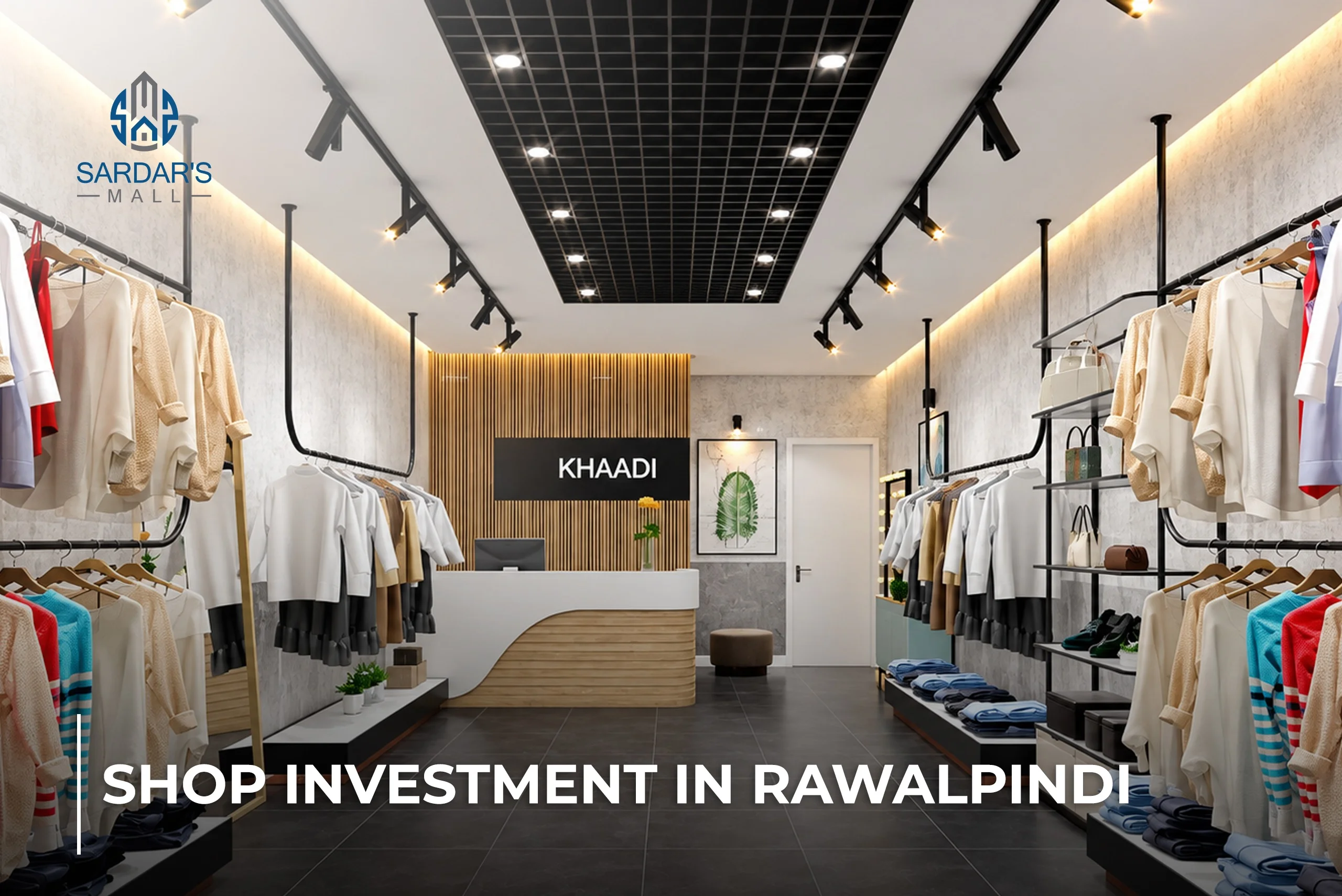
The right retail shop investment in Rawalpindi depends on more than the purchase price. You should assess location, visibility, customer footfall, shop size, floor, accessibility, parking, rental demand, total acquisition cost, developer credibility, and future resale potential before investing.
For investors considering a mall-based commercial property, Sardar’s Mall offers retail units across the ground, first, and second floors, with different spaces designed for flagship stores, boutiques, cafés, restaurants, and other businesses. The project is an RDA-approved mixed-use development with retail, offices, apartments, and a food court.
Why Shop Investment in Rawalpindi Can Be Attractive
Commercial property remains a popular investment category because a well-located shop can generate rental income while also appreciating.
But commercial property isn’t automatically profitable. A shop in a weak location can remain vacant even when the broader property market is performing well.
Rawalpindi’s commercial activity is spread across established markets, main roads, shopping centres, mixed-use developments, and emerging commercial zones. This gives investors plenty of options, but it also makes property selection more important.
How to Choose the Right Shop for Investment in Rawalpindi
The right retail shop investment in Rawalpindi depends on the following factors:
1. Start With the Location
Location should be your first filter. A retail shop needs customers. If reaching the shop is difficult, visibility is poor, or the surrounding area doesn’t generate enough activity, even a beautifully designed unit can struggle.
When evaluating a shop in Rawalpindi, check:
- Main road and secondary road access
- Nearby residential communities
- Public transport availability
- Road connectivity
- Surrounding commercial activity
- Parking availability
- Visibility from the main entrance or road
- Nearby offices, restaurants, schools, hospitals, and other businesses
- Future infrastructure and development
A strong location can support both rental demand and resale value.
For example, Sardar’s Mall is located on Iran Road in Satellite Town, Rawalpindi, and is planned as a mixed-use development combining retail, offices, apartments, and a food court.
2. Evaluate Customer Footfall
High footfall is one of the most important factors in retail investment. A shop depends on people seeing it, reaching it, and having a reason to enter. This makes pedestrian movement, vehicle traffic, neighbouring businesses, and the overall tenant mix important.
Try to assess the area at different times:
- Morning
- Afternoon
- Evening
- Weekends
- Public holidays
3. Choose the Right Floor
The floor can significantly affect a retail shop’s visibility, accessibility, and price.
Ground-floor shops generally have an advantage for businesses that rely heavily on spontaneous walk-ins. They can suit flagship stores, fashion outlets, banks, convenience businesses, and brands that need strong visibility.
First- and second-floor shops can also work well when the mall provides effective vertical circulation, and the business category gives customers a reason to visit.
Sardar’s Mall has retail spaces on the ground, first, and second floors. The ground floor is positioned for high-visibility and flagship retail. The first and second floors are intended for boutiques, cafés, restaurants, and mid-range brands.
The right floor depends on your business model, target customer, and expected rental demand.
4. Check Shop Size and Layout
A larger shop isn’t necessarily a better investment. You should choose a size that matches the businesses likely to rent or operate from the unit.
| Shop Type | Suitable Considerations |
| Small retail shop | Accessories, cosmetics, mobile products, small speciality stores |
| Medium shop | Fashion, footwear, lifestyle, service businesses |
| Large retail unit | Showrooms, flagship stores, furniture, larger brands |
| Kiosk | Snacks, beverages, impulse purchases |
| Restaurant/café space | Dining area, kitchen requirements, customer circulation |
The layout matters just as much as the area. Sardar’s Mall states that its retail units range from smaller kiosks to larger storefronts, offering businesses different space options to meet their requirements.
5. Compare Visibility and Frontage
Two shops with the same area can have very different investment potential. A shop facing a major entrance, prominent corridor, escalator, lift lobby, or high-traffic section may receive more exposure than a similarly sized unit hidden in a less active corner.
Pay particular attention to:
- Frontage width
- Glass frontage
- Signage opportunities
- Distance from entrances
- Proximity to escalators and lifts
- Corridor visibility
- Corner positioning
- Sightlines from major customer routes
Sardar’s Mall highlights large glass windows and prime frontage as features of its retail spaces. It also has six lifts, four capsule lifts, and escalators serving the retail areas.
6. Look at Parking and Accessibility
Customers may avoid a commercial destination if parking is difficult. This is especially important for family shopping, restaurants, larger purchases, and businesses that depend on repeat customers.
Before buying, check:
- Number of parking spaces
- Basement parking arrangements
- Entry and exit points
- Lift access from parking
- Escalator locations
- Accessibility for elderly customers
- Delivery access
- Traffic flow around the property
Sardar’s Mall includes two basement levels and lists ample parking and vertical access among its facilities. These features can improve the overall usability of a commercial property.
7. Study the Tenant Mix
A mall’s tenant mix can directly influence the attractiveness of individual shops. Imagine a mall filled with businesses that serve completely different customer groups. Footfall may be inconsistent.
Now compare that with a development where retail, dining, offices, and residential spaces support one another. That’s the idea behind a mixed-use commercial development.
Sardar’s Mall combines shopping, offices, apartments, and a food court, creating several potential sources of daily activity within the same development.
When evaluating a shop, ask:
- What businesses are expected to operate nearby?
- Are there complementary businesses around the unit?
- Will the tenant mix attract the target customer?
- Are there competing shops on the same floor?
- Is the mall targeting premium, mid-market, or mass-market customers?
The answers can help you estimate future rental and resale demand.
8. Verify Approval and Ownership Documents
Before making a payment, verify the project’s approval status and all relevant documentation through the appropriate authorities and qualified professionals.
Check:
- NOC or approval status
- Approved building plans
- Ownership documents
- Seller or developer authority
- Unit allocation documents
- Payment schedule
- Transfer procedure
- Development charges
- Possession terms
- Cancellation and refund conditions
- Any outstanding liabilities
Sardar’s Mall identifies itself as an RDA-approved project on its official website. Investors should still verify current documentation and the specific unit’s legal status before committing funds.
9. Consider an Under-Construction Shop Carefully
Buying during construction can provide an opportunity to enter a project before completion. At Sardar’s Mall, construction is currently ongoing, and the official project information states that retail shops occupy the ground, first, and second floors.
You should consider:
- Construction timeline
- Payment obligations
- Potential delays
- Market conditions at completion
- Future rental demand
- Developer execution
- Exit options before possession
The lower entry price of under-construction shops automatically makes it a better investment. You still need to assess the project fundamentals.
Why Sardar’s Mall Can Be Considered for Shop Investment in Rawalpindi
For investors looking specifically at mall-based retail property, Sardar’s Mall brings several components together.
The project is planned as a mixed-use development with retail shops, corporate offices, apartments, and a food court. Its official project information lists two basement levels, ground plus 10 floors, and RDA approval.
Its retail section spans the ground, first, and second floors. The project also highlights flexible retail sizes, frontage, modern layouts, parking, lifts, and escalators.
The third floor is dedicated to the food court, while offices are planned for the fourth and fifth floors. This creates a combination of retail, dining, business, and residential activity within the same development.
Common Mistakes to Avoid When Buying a Shop in Rawalpindi
- Buying only because the price is low. A cheap shop can become expensive if it remains vacant or has weak resale demand.
- Ignoring the floor. A lower price on an upper floor doesn’t necessarily compensate for lower visibility.
- Assuming footfall without checking. Visit the location yourself. Don’t rely entirely on promotional claims.
- Calculating ROI on purchase price alone. Include taxes, charges, maintenance, fit-out costs, and vacancy assumptions.
- Ignoring the tenant profile. A shop should match the businesses and customers the project is likely to attract.
- Skipping document verification. Always verify approvals, ownership, payment terms, and unit documentation before paying.
- Expecting guaranteed returns. No commercial property investment guarantees a specific rental yield or capital gain.
Book Your Pre-Launch Shop at Sardar’s Mall
Investing in Sardar’s Mall is a step toward securing a strong commercial future in a prime business location. Make your decision today and become part of a growing retail destination designed for long-term success and opportunity.
Choose your preferred shop, floor, and payment plan before making your investment decision. Contact the Sardar’s Mall team for current availability and pricing.
FAQs
Is investing in a shop in Rawalpindi a good option?
Shop investment can be a good option when the property has a strong location, consistent footfall, rental demand, accessibility, and resale potential. Always evaluate the specific shop rather than the market alone.
What should I check before buying a shop in Rawalpindi?
Check the location, floor, visibility, shop size, frontage, parking, expected rental income, total purchase cost, project approvals, developer record, and payment terms before investing.
Is buying a shop in a mall a good investment?
A mall shop can offer access to organized footfall, shared facilities, parking, and a planned tenant mix. However, returns depend on the mall’s location, occupancy, management, tenant mix, and individual shop position.
How do I calculate the ROI on a retail shop?
Calculate the expected annual rental income against your total investment. The basic formula is: Gross Rental Yield = Annual Rent ÷ Total Investment × 100. Include maintenance, taxes, vacancy, and other expenses for a more realistic estimate.
Which floor is best for a retail shop?
Ground-floor shops usually offer stronger visibility and easier access, while upper-floor shops can work well for cafés, boutiques, offices, and businesses that attract destination-based customers. The best floor depends on the property’s layout and tenant mix.
Why consider Sardar’s Mall for shop investment in Rawalpindi?
Sardar’s Mall is a mixed-use commercial project featuring retail shops, offices, apartments, and a food court. Investors can compare different retail spaces based on floor, size, visibility, accessibility, and investment requirements.
How can I check shop availability at Sardar’s Mall?
Contact the Sardar’s Mall sales team to check current shop availability, prices, floor plans, and payment options. You can also arrange a site visit before making your investment decision.