
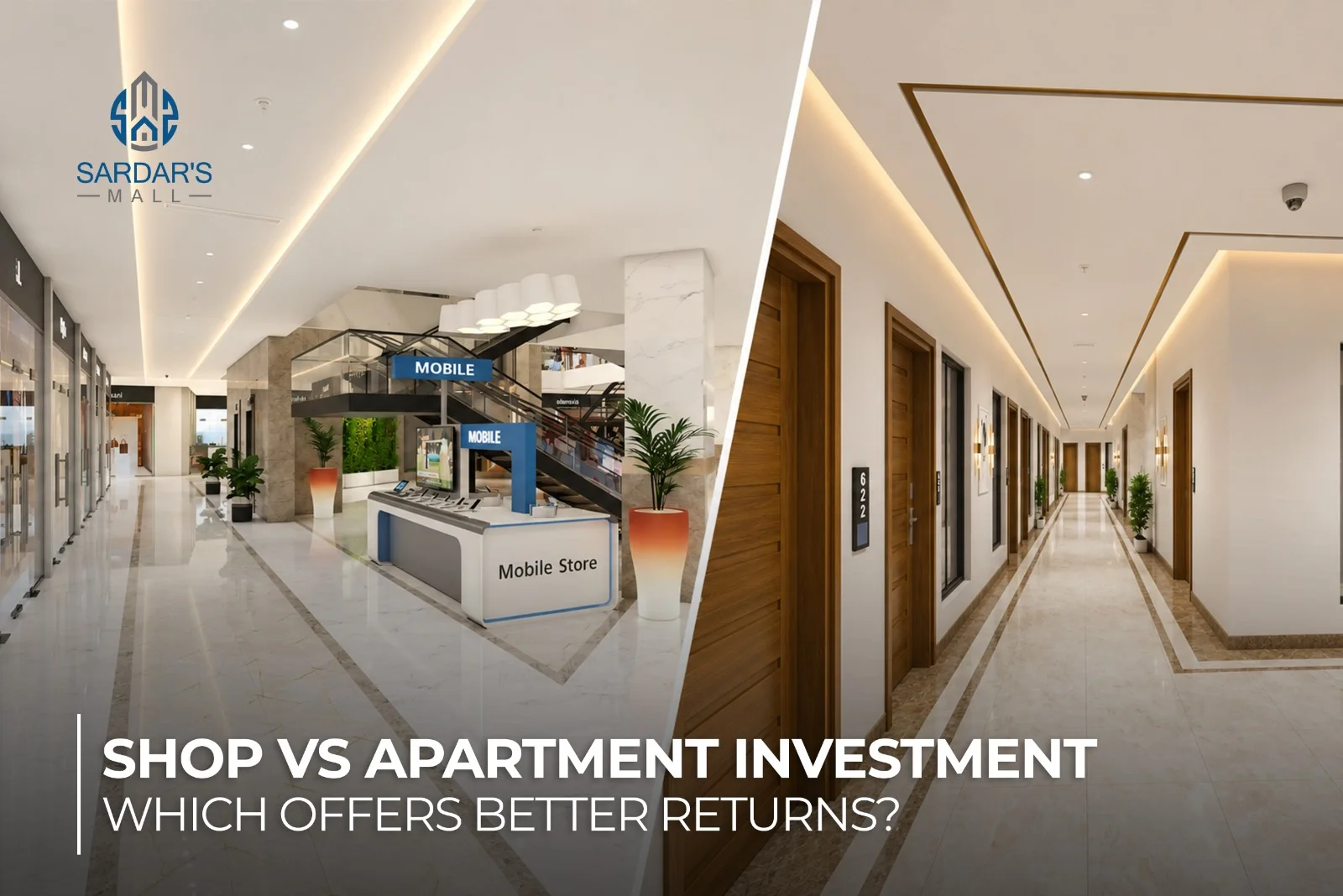
A shop generally delivers higher rental income, while an apartment offers steadier demand and easier resale. The right choice depends on your budget, income goals, and risk tolerance.
Both options sit inside the same premium mixed-use development in Rawalpindi. Both benefit from the same location, footfall, and infrastructure. But they behave very differently as investments: different returns, different risks, and different timelines.
This guide breaks down the real differences between commercial and residential investment in Pakistan. At Sardar’s Mall, you can match the right option to your financial goals.
What Is a Commercial Shop Investment?
A commercial shop investment means purchasing a retail unit in a commercial building, shopping mall, or business center to earn rental income or benefit from its value increasing over time. It’s a popular real estate investment for those seeking steady returns and long-term capital growth.
Benefits of Investing in Commercial Spaces
Commercial spaces offer higher rental income, longer lease terms, and stronger returns than many residential properties. They also provide steady cash flow and better long-term appreciation in prime business locations.
Higher Rental Yields
Commercial retail space typically generates higher rental yields than residential property, often in the range of 8–12% annually for well-located units in Pakistan, compared to 4–6% for residential units. Yields vary by city, location, and unit quality, so treat these as general benchmarks rather than guarantees.
Business-Driven Demand
Retail tenants, such as clothing brands, electronics stores, mobile shops, salons, F&B outlets, actively seek space in high-footfall locations. Demand is tied to business activity and consumer spending, not just population growth.
Longer Lease Commitments
Commercial tenants, especially established brands, often sign multi-year leases. This can mean more stable, predictable income compared to residential tenants who tend to turn over more frequently.
Value Tied to Footfall and Location
A shop’s income potential is closely linked to how much foot traffic its location generates. Units in high-footfall developments, including ground floors, anchor positions, and near food courts or entrances, tend to command stronger rents and hold value better over time.
Considerations
- Higher Entry Cost: Commercial units generally cost more per square foot than residential apartments in comparable developments.
- Vacancy Risk: If a shop sits empty, there’s no rental income until a new tenant is found. Commercial vacancies can take longer to fill than residential ones, particularly for larger or more specialized units.
- Market-Dependent Performance: Retail investment performance is closely tied to consumer spending and local business conditions. Economic slowdowns can affect footfall and tenant demand more directly than they affect housing demand.
- More Active Management: Commercial leasing often involves more negotiation, tenant vetting, and ongoing relationship management than residential renting.
What Is a Residential Apartment Investment?
A residential apartment investment means buying a housing unit to rent out or resell, where returns come from population growth and housing demand rather than business activity.
An apartment is a housing-facing asset; your returns depend on population growth, household formation, and how desirable the location is to live in.
Benefits of Investing in Apartments
Residential apartments offer consistent rental demand, lower maintenance responsibilities, and steady long-term appreciation. They also provide regular passive income while appealing to a broad range of tenants, making them a relatively stable real estate investment.
Steadier, Broader Demand
Housing demand is driven by population growth and the ongoing shift toward apartment living among professionals and small families in Pakistan’s major cities. This demand tends to be less sensitive to short-term economic swings than retail demand.
Easier to Rent or Resell
Apartments have a wider pool of potential tenants and buyers. Professionals, families, and overseas Pakistanis looking for a home base, which generally makes them easier to lease or sell than a specialized commercial unit.
Lower Entry Point
Apartments typically cost less per unit than commercial shops in the same development, making them more accessible for first-time property investors.
Lower Management Overhead
Residential leasing is usually more straightforward than commercial leasing, with more standardized terms and less negotiation.
Considerations
- Lower Rental Yields: Residential rental income is typically more modest than commercial income, though it’s often more consistent.
- Slower Capital Appreciation: Residential property values usually appreciate steadily rather than sharply, depending on broader real estate trends in the city.
- Tenant Turnover: Residential leases are often shorter than commercial ones, which can mean more frequent tenant changes and occasional vacancy gaps.
Shop vs Apartment: Side-by-Side Comparison
Shops win on rental yield and lease length; apartments win on affordability, demand stability, and resale liquidity.
| Factor | Commercial Shop | Residential Apartment |
| Typical rental yield | Higher (business-driven) | Lower but more stable |
| Entry cost | Higher per square foot | Generally more affordable |
| Tenant pool | Retail businesses, brands | Professionals, families, overseas buyers |
| Lease length | Often longer-term | Often shorter-term |
| Demand driver | Consumer spending, footfall | Population growth, housing need |
| Vacancy risk | Can be higher for niche/large units | Generally easier to re-let |
| Management effort | Higher active leasing and tenant vetting | Lower and more standardized |
| Ideal for | Investors seeking higher income | Investors seeking stability or end-use |
These are general market patterns for commercial vs residential investment in Pakistan. Actual figures for any specific project depend on location, floor, unit size, and market conditions at the time of purchase.
Always confirm specifics with the developer or sales team before deciding.
Who Should Invest in a Shop?
A shop suits income-focused investors with a larger budget who are comfortable with active, business-oriented management.
Consider a shop if you:
- Want higher rental income and are comfortable with more active management
- Have a larger investment budget
- Understand or are willing to research retail and business trends in your target city
- Are investing primarily for returns, not personal use
- Can tolerate short vacancy periods between tenants
Retail business owners and entrepreneurs looking to occupy their own unit, rather than rent it out. A well-located shop doubles as prime business real estate.
Who Should Invest in an Apartment?
An apartment suits first-time investors, overseas buyers, and families who prioritize accessibility, stability, and low-maintenance ownership over maximum yield.
Consider an apartment if you:
- Are a first-time property investor looking for a more accessible entry point
- Are an overseas Pakistani wanting a home base or a low-maintenance investment to manage remotely
- Are a family relocating to or investing in a growing residential corridor
- Are a working professional who wants to live close to work and amenities
- Prioritize stability and ease of resale over maximum yield
How to Decide: A Simple Framework
The easiest way to decide is to ask yourself one question: do you want more rental income, or want an easier, safer investment?
- Want higher monthly income? Go with a shop. It earns more rent, but you’ll need a bigger budget and more patience if it takes time to find a shopkeeper.
- Want something simple and low-risk? Go with an apartment. It costs less to buy, is easier to rent out or sell later, and needs less day-to-day involvement.
- Want to run your own business or live in it yourself? A shop makes sense if you plan to open your own store there. An apartment makes sense if you or your family plan to live in it.
- Have a bigger budget and want the best of both? Many investors buy one of each, a shop for steady income and an apartment for security, especially when both are in the same project.
The best choice is simply the one that fits your budget, risk you’re comfortable with, and what you actually need this investment to do for you.
Sardar’s Mall: Shop vs Apartment Investment in Rawalpindi
Sardar’s Mall, a mixed-use development in Rawalpindi, offers both shop and apartment units within a single integrated project.
The building is organized so each floor serves a distinct purpose:
- Ground, 1st, and 2nd floors: Retail shops for fashion, electronics, and everyday commercial brands
- A dedicated food court on the 3rd floor
- Corporate office spaces on 4th and 5th floors
- Residential apartments on 6th–10th floors
If you’re leaning toward a shop:
Sardar’s Mall’s ground-floor and lower-floor retail units are positioned to capture high footfall from the food court, offices, and residences.
If you’re leaning toward an apartment:
Sardar’s Mall’s residential floors offer the accessibility and lifestyle typical of apartment living, one of the strongest residential demand drivers in the Rawalpindi corridor.
If you want both:
Sardar’s Mall allows investors to diversify within a single project, pairing a commercial unit for income with a residential unit for stability at one place.
Ready to Choose? Here’s Your Next Step
Shop vs apartment isn’t really a competition. It’s a matter of fit. Shops reward investors who want higher income and are comfortable with active management. Apartments reward investors who want stability, accessibility, and a broader resale market.
Sardar’s Mall in Rawalpindi has both options in one place, built around lifestyle convenience in Satellite Town, near Chandni Chowk Rawalpindi. That makes it a practical starting point for comparing the two in real terms.
Ready to explore your options? Schedule a visit to book the available shop and apartment units in person and get current pricing from our sales team.
Frequently Asked Questions
Is a shop or an apartment a better investment in Pakistan?
Neither is universally better. Shops offer higher rental yields but need a bigger budget. Apartments offer steadier demand and easier resale. The right choice depends on your budget and goals.
Which gives better rental returns, a shop or an apartment?
A shop. Retail rents are driven by business revenue, which typically pushes yields higher than residential rents. Shops also carry more vacancy risk in exchange for that extra income.
Is a shop or apartment easier to resell?
An apartment. It has a broader buyer pool, including professionals, families, and overseas buyers, so it’s usually easier to resell than a specialized commercial unit.
Can overseas Pakistanis invest in Sardar’s Mall?
Yes. Sardar’s Mall accepts both local and overseas investors, with documentation support for non-resident buyers.
Is it possible to invest in both a shop and an apartment at Sardar’s Mall?
Yes. Many investors buy both: a commercial unit for income and a residential unit for stability or personal use.
What is the minimum investment required for a shop or apartment at Sardar’s Mall?
Pricing depends on floor, size, and unit location. Contact the Sardar’s Mall sales team for current rates and available inventory.